

It’s 8:14am. You’re running late, the kids can’t find a single matching shoe between them, and you’ve just walked into the kitchen with great purpose. You stand there. You open the fridge. You close the fridge. You have absolutely no idea why you came in.
Meanwhile your keys have vanished, the word you need in the middle of a sentence has gone with them, and the thing you definitely, absolutely had to remember today is now just a vague feeling of dread.
If your memory seems to fall apart precisely when you need it most, you’re not imagining it, and you’re not losing it either. The link between stress and memory is well researched, and your brain is doing exactly what it was built to do. It’s just that it was built for a world with more lions and fewer school lunchboxes.
What the research says about stress and memory
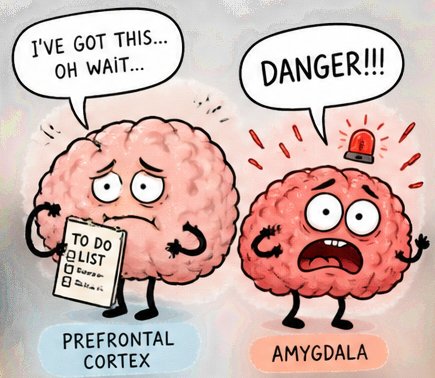
The part of your brain that holds your to-do list, keeps your train of thought on the rails and stops you saying the first thing that pops into your head is the prefrontal cortex, sitting just behind your forehead. It’s clever, but it’s also a bit of a diva. Neuroscientist Amy Arnsten’s major review of the research on stress and the prefrontal cortex found that “even quite mild acute uncontrollable stress can cause a rapid and dramatic loss of prefrontal cognitive abilities.” At the same time, the stress chemicals that switch the prefrontal cortex down switch up the amygdala, the brain’s alarm system, which is much better at reacting fast than thinking carefully.
What does that look like in everyday life? A meta-analysis pulling together 51 studies and almost 2,500 people found that acute stress reliably impairs working memory (the mental sticky note where you hold information while you use it) and cognitive flexibility (your ability to switch tracks when plans change). Interestingly, the researchers found this wasn’t simply down to cortisol, the hormone usually blamed for everything. Stress affects the brain through several chemical messengers at once.
Stress also makes it harder to pull out things you already know, which is why a word, a name or your PIN can vanish mid-sentence and pop back an hour later. And if your attention was elsewhere when you put your keys down, the memory of where they went may never have been properly stored in the first place.
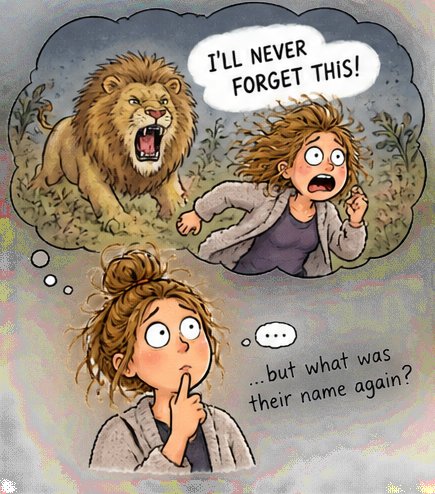
Here’s the twist, though. Stress doesn’t make your memory worse across the board. A major review of stress and memory describes how stress hormones put the brain into a kind of “memory formation mode” for the stressful event itself, while dampening anything that competes with it. That’s why you can remember every detail of the moment you thought you’d lost your child at the shops, but not the name of the person you met five minutes earlier.
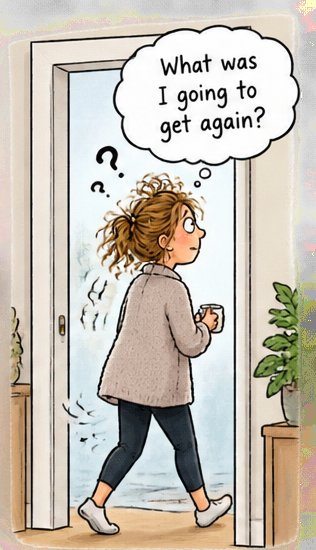
And that fridge moment? It has a name. Researchers at the University of Notre Dame found that walking through a doorway acts as an “event boundary” for the brain. Your memory files the previous room away as a finished episode and opens a new one, so the reason you came in often stays behind in the old room. Add a stressed, overloaded working memory to the mix and it’s easy to see why the fridge gets so many unexplained visits.
Myth vs fact
“Stress always makes your memory worse.”
Stress weakens working memory and recall of everyday details, but it can strengthen memory for the stressful event itself.
“Forgetting things means your memory is declining.”
Forgetting under pressure is usually a sign of an overloaded brain, not a failing one. Memory often bounces back once the pressure eases.
“It’s all cortisol’s fault.”
Cortisol plays a part, but stress works through several brain chemicals at once, including adrenaline-like messengers that act within seconds.
It’s a feature, not a flaw
From an evolutionary point of view, this all makes perfect sense. If a predator is heading your way, you don’t need careful planning, a tidy mental to-do list or the ability to recall where you parked. You need to move, fast, and remember forever that this particular bush is a bad idea. Your stress system is very good at exactly that.
The trouble is that your brain can’t tell the difference between a lion and a full inbox, a tense phone call or a morning where everyone needs something from you at once. It throws the same switch. The thinking part of your brain steps back, the alarm system steps forward, and your keys end up somewhere that made perfect sense at the time.
The good news is that this is mostly temporary. When stress passes, the prefrontal cortex comes back online. The longer-term problem is when stress never really passes, because a brain that is constantly on high alert gets very little chance to recover. That’s when people start to worry that something more serious is going on, when often what they need is a proper break and some support to manage the load.
A stressful moment
Focus narrows, everyday memory dips, and it bounces back when the pressure passes.
Stress that never switches off
The alarm stays on, your brain never gets the chance to recover, and forgetting starts to feel normal.
Memory savers for stressful weeks
You can’t always remove the stress, but you can stop relying on the part of your brain that stress switches off first.

When it’s worth looking into further
Most stress-related forgetting eases when life calms down. It’s worth checking in with your GP if memory problems are getting steadily worse, if they stick around even on quiet, well-rested weeks, or if people close to you have started to notice. Plenty of very treatable things can affect memory, including poor sleep, thyroid problems, low iron or B12, some medications, and depression or anxiety, so it’s worth ruling those out.
If stress itself is the problem, and it’s been running the show for a while, talking it through with a psychologist can help you work out what’s driving it and build practical ways to bring the load down. The aim isn’t to make life stress-free, which would be nice but unlikely. It’s to give your prefrontal cortex a fighting chance, so you can find your keys, finish your sentences and walk into the kitchen knowing exactly why you’re there.
If you’d like to talk it through with Sarah K Psychology, you’ll find our fees and how to get started on our Services page.
References
Arnsten, A. F. T. (2009). Stress signalling pathways that impair prefrontal cortex structure and function. Nature Reviews Neuroscience, 10, 410–422.
Radvansky, G. A., Krawietz, S. A., & Tamplin, A. K. (2011). Walking through doorways causes forgetting: Further explorations. Quarterly Journal of Experimental Psychology, 64(8), 1632–1645.
Schwabe, L., Joëls, M., Roozendaal, B., Wolf, O. T., & Oitzl, M. S. (2012). Stress effects on memory: An update and integration. Neuroscience and Biobehavioral Reviews, 36(7), 1740–1749.
Shields, G. S., Sazma, M. A., & Yonelinas, A. P. (2016). The effects of acute stress on core executive functions: A meta-analysis and comparison with cortisol. Neuroscience and Biobehavioral Reviews, 68, 651–668.