

A concussion rarely looks dramatic. You slip on a wet floor, clash heads at footy or netball, or get jolted in a minor car accident. Someone asks how many fingers they’re holding up, you get it right, and everyone agrees you were lucky.
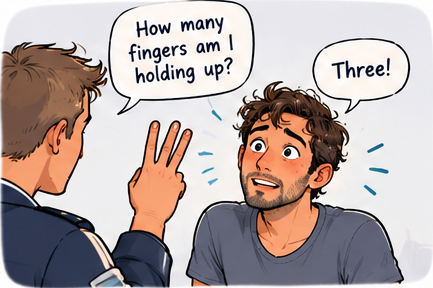
The medical name for a concussion is a mild traumatic brain injury, or mTBI. “Mild” refers to the severity of the injury in the first 24 hours: whether you lost consciousness and for how long, how long your memory was affected afterwards, and how alert and oriented you were. It doesn’t describe how the following weeks feel. Many people are caught off guard by headaches, fatigue and a brain that seems to have switched to dial-up. Others are just as surprised by how they feel emotionally.
This post looks at what the research says about recovery and mood after concussion, why the two are so tangled together, and what actually helps.
The good news first
Most people recover well. In a Finnish study, about 6 in 10 adults were back at work within two weeks of a concussion, and more than 9 in 10 within two months.
That said, being back at work isn’t always the same as feeling back to normal. A 2016 New Zealand study followed people with concussion from across the community, many of whom were never seen at a hospital. A year on, nearly half still had several lingering symptoms, most often headaches, fatigue, forgetfulness and poor concentration. If that’s you, you’re not imagining it, you’re not being dramatic, and you’re far from alone.
The part nobody warns you about
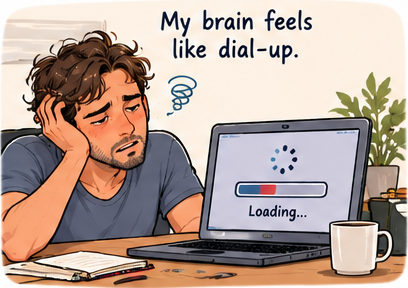
Most concussion advice focuses on the physical side: headaches, dizziness and rest. Mood gets far less airtime, even though changes are common.
The same New Zealand study found that anxiety was most common straight after the injury, when around 4 in 10 people had raised anxiety symptoms. About 1 in 6 had raised symptoms of depression in the first month. By the end of the year, these levels were similar to those in the general population. That’s an average, though, and a year is a long time to feel anxious or flat. A four-year follow-up also found that mood and sleep problems were linked to memory and concentration problems lasting longer, so they’re worth treating rather than waiting out.
The changes people describe most often are:
- A shorter fuse. Small things, like a dripping tap or a slow driver, suddenly feel unbearable.
- Low mood. Feeling flat, teary or uninterested in things you usually enjoy.
- Worry. Often about whether your brain has properly healed, which can turn every forgotten word into evidence.
- Poor sleep and fatigue. Tired all day, yet somehow wide awake at night.
- Feeling overwhelmed. Busy shopping centres, noisy rooms and group chats can all feel like too much.
Why it happens
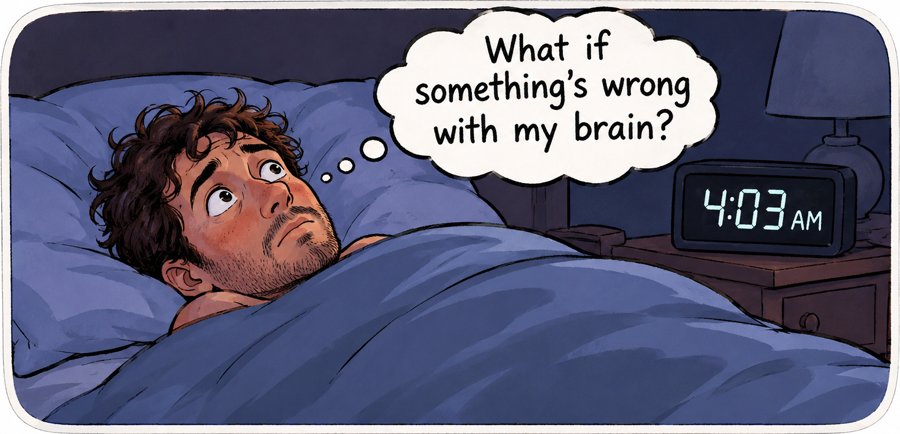
There is rarely one single cause. The injury itself, pain, broken sleep, time off work or sport, and the event that caused it can all play a part. If the concussion happened in something frightening, such as a crash or an assault, trauma reactions may also be part of the picture.
These factors tend to feed each other. Poor sleep makes concentration and mood worse. Worry about symptoms increases tension, and tension makes headaches worse. Stepping back from work, exercise and friends removes the very things that usually keep us well.
There is also a lot of overlap. Fatigue, irritability, poor concentration and sleep problems are common after concussion, but they are also classic signs of stress, anxiety and depression. It can be hard to tell which is which, and often it’s a mix of both. That is why it helps to look at the whole picture, not just the bump on the head.
Myth vs fact
“Rest in a dark room until you feel completely better.”
A day or two of relative rest helps. After that, a gradual return to normal activity is generally recommended.
“The scan was normal, so nothing is wrong.”
Concussion doesn’t usually show on a standard scan. Symptoms can still be real and take time to settle.
“If it’s affecting my mood, it must be all in my head.”
Mood changes after concussion are common and treatable. They are part of recovery for many people, not a sign of weakness.
What helps
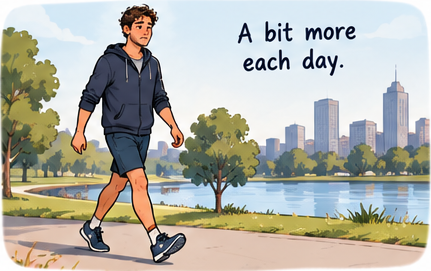
International guidelines now recommend clear information about what to expect, relative rest for the first 24 to 48 hours, and then a gradual return to normal activities. Long periods of rest tend to slow recovery rather than speed it up. Cognitive behavioural therapy (CBT) doesn’t treat the injury itself, but it is a first-line treatment for depression and anxiety after concussion, and it can help when worry, low mood or poor sleep hang around. Medication through your GP is also an option.
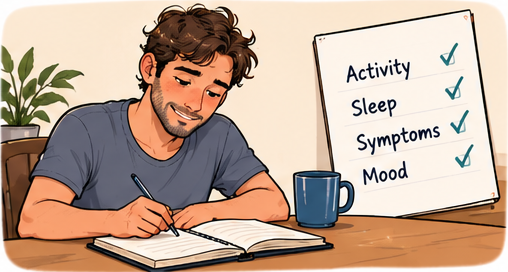
In practice, recovery is mostly about small, steady steps.
When to seek help
Go to an emergency department or call 000 straight away if, after a head injury, you have any of these warning signs:
- A severe headache, or one that is getting worse
- Repeated vomiting
- Increasing drowsiness, confusion or agitation
- Loss of consciousness
- A seizure
- Double vision or slurred speech
- Weakness, numbness or tingling in your arms or legs
- Neck pain or tenderness
For anything new or worsening physically, your GP is the first stop. It’s also worth talking to someone about the emotional side if:
- Your mood, worry or irritability hasn’t improved after a few weeks
- You’re avoiding activities or people because of how you feel
- Sleep problems are hanging around
- The event that caused the injury keeps replaying in your mind
If you’re struggling right now, call Lifeline on 13 11 14. In an emergency, call 000.
References
healthdirect Australia. (n.d.). Concussion.
Silverberg, N. D., et al. (2020). Management of concussion and mild traumatic brain injury: A synthesis of practice guidelines. Archives of Physical Medicine and Rehabilitation, 101(2), 382–393.
Theadom, A., Parag, V., Dowell, T., et al. (2016). Persistent problems 1 year after mild traumatic brain injury: A longitudinal population study in New Zealand. British Journal of General Practice, 66(642), e16–e23. https://doi.org/10.3399/bjgp16X683161
Theadom, A., Starkey, N., Barker-Collo, S., et al. (2018). Population-based cohort study of the impacts of mild traumatic brain injury in adults four years post-injury. PLOS ONE, 13(1), e0191655. https://doi.org/10.1371/journal.pone.0191655
Wäljas, M., Iverson, G. L., Lange, R. T., et al. (2014). Return to work following mild traumatic brain injury. Journal of Head Trauma Rehabilitation, 29(5), 443–450. https://pubmed.ncbi.nlm.nih.gov/24263178/
This article is general information, not a substitute for individual or medical advice.